
Professional
Fire Safety
Certification
From basic fire awareness to advanced fire warden and emergency response — STCS PK delivers hands-on, practical fire safety training trusted by industries across Pakistan and Saudi Arabia.
4 Levels
Course Tiers
1–5 Days
Duration
Hands-On
Practical Training
Gulf Accepted
Recognition
Why Fire Safety Training Is Non-Negotiable for Every Workplace
Fire is one of the most devastating and preventable workplace hazards. In Pakistan and the Gulf, fire incidents in factories, construction sites, and commercial buildings cause thousands of injuries and billions in losses every year.
Proper fire safety training equips your team to prevent fires before they start, respond correctly when they do, and protect lives and property in every emergency. STCS PK offers a full spectrum of fire safety courses — from basic employee awareness to advanced fire safety management — all delivered with live practical drills, real equipment, and expert instructors.
Our programs are accepted by Gulf employers and recognized across Pakistan’s industrial and public sectors, making them ideal for both local career advancement and overseas employment.
Did You Know? Fire Safety Is Mandatory for Gulf Employment
Most Saudi Arabian, UAE, and Qatar employers in construction, oil & gas, and hospitality require fire safety certification as a condition of employment. STCS PK's programs meet these requirements.
Fire Safety Awareness
All Employees — Entry Level
Designed for entry-level workers and new employees. Covers fundamental occupational safety topics to increase awareness of hazards and rights in the workplace. Ideal for workers entering construction, manufacturing, or general industry.
1 Day
Short Assessment
All 5 Branches
Live Fire Demo
Certificate Issued
All Staff
Fire Warden / Marshal Course
Designated Wardens & Team Leaders
A comprehensive 2-day course for designated fire wardens and marshals. Covers warden duties, floor evacuation management, fire detection systems, and working with emergency services.
2 Days
Written + Practical
All 5 Branches
Live Drill Exercise
Warden Certificate
Wardens & Marshals
Fire Emergency Response
Safety Officers & HSE Personnel
A 3-day intensive program for HSE officers, safety managers, and emergency response team members. Covers fire fighting techniques, rescue operations, hazardous materials, and incident command.
3 Days
Theory + Field Practical
Controlled Fire Fighting
HSE Officers
Emergency Response Cert
Gulf Accepted
What You’ll Be Able to Do After Training
Competencies gained from STCS PK’s Fire Safety programs — practical
skills you can apply from day one.
Identify Fire Hazards & Risks
Recognize common ignition sources, fuels, and oxidizers in industrial and commercial environments.
Execute Emergency Evacuations
Lead orderly floor evacuations, account for all personnel, and coordinate with emergency services.
Operate Detection & Alarm Systems
Understand fire detection technologies, alarm systems, and suppression system activation.
Coordinate with Emergency Services
Interface with fire brigade, provide accurate incident briefs, and support emergency operations.
Select & Use Fire Extinguishers
Match the correct extinguisher type to each fire class and operate it safely and effectively.
Conduct Fire Risk Assessments
Systematically assess fire risks, document findings, and implement corrective control measures.
Manage Hot Work Permits
Issue and supervise hot work permits for welding, cutting, and grinding operations safely.
Investigate Fire Incidents
Analyze fire causes, determine contributing factors, and produce actionable investigation reports.
Fire Warden Course — Full Curriculum
Our most popular fire safety program — a practical 2-day course that
creates competent, confident fire wardens for any workplace.
01 Fire Science Fundamentals
- The fire triangle and fire tetrahedron — combustion chemistry explained
- How fires start, spread, and accelerate in different environments
- Fire classes — A, B, C, D, E, F and their specific hazard profiles
- Stages of fire development — incipient, growth, fully developed, decay
02 Fire Prevention & Hazard Control
- Identifying common ignition sources — electrical faults, hot work, smoking areas
- Flammable and combustible material storage and handling requirements
- Good housekeeping as a fire prevention strategy
- Hot work permit-to-work systems for welding, grinding, and cutting
03 Fire Detection & Alarm Systems
- Types of fire detectors — smoke, heat, flame, gas, multi-sensor
- Manual call points, sounders, and visual alarm devices
- Fire control panels — basic operation and zone identification
- False alarm management and detector maintenance requirements
04 Fire Extinguishers — Theory & Practical
- Water, CO₂, dry powder, foam, wet chemical, and halon types
- PASS technique — Pull, Aim, Squeeze, Sweep — live fire practical
- Matching extinguisher class to fire class
- Extinguisher inspection, maintenance, and placement requirements
05 Fire Warden Duties & Responsibilities
- Legal duties of fire wardens under Pakistani and international fire codes
- Pre-emergency preparedness — floor checks, roll calls, route familiarization
- ties during fire — raising alarm, assisting evacuation, sweep procedures
- Post-emergency actions — roll call at assembly point, reporting to fire brigade
06 Emergency Evacuation Procedures
- Designing and reviewing fire emergency evacuation plans (FEEP)
- Emergency exit requirements — signage, lighting, width, and clearance
- Managing vulnerable persons — mobility-impaired, visitors, contractors
- Full evacuation drill exercise — practical, timed, and debriefed
07 Fire Risk Assessment
- Legal requirements for fire risk assessment in workplaces
- 5-step fire risk assessment methodology
- Identifying fire hazards, people at risk, and existing controls
- Recording, reviewing, and updating fire risk assessments
08 Suppression Systems & Special Hazards
- Sprinkler system types — wet pipe, dry pipe, deluge, pre-action
- Gaseous suppression systems — CO₂, FM200, Novec 1230
- Kitchen suppression systems for cooking hazards
- Special hazards — server rooms, fuel storage, transformer areas
🧯 What Makes STCS Different
🔥 Live fire practical: Real controlled fire scenarios — not just classroom theory
🚒 Full evacuation drills: Timed, realistic drills with post-drill debrief
🧯 Hands-on extinguisher use: Every student operates a live extinguisher
👨🏫 Expert instructors: Former fire brigade officers & industrial HSE professionals
✈️ Career Opportunities After Fire Safety
🇸🇦 Fire Safety Officer — Saudi construction & oil sector
🏨 Fire Warden — hotels, hospitals, commercial buildings
🏭 Fire Safety Inspector — manufacturing & factories
⛽ Emergency Response Coordinator — oil & gas
🏗️ Site Fire Safety Supervisor — construction projects
🛡️ HSE Manager — combined safety & fire role
🚀 Enroll in the Next Batch
All 5 Branches Available
Flexible Scheduling
Understanding Fire Classes
& Hazards
You can’t fight a fire you don’t understand. STCS PK trains you to identify every
fire class and respond with the right technique and equipment.
Ordinary Combustibles
Wood, paper, cloth, rubber, and most plastics. Use water or dry powder extinguishers.
Flammable Liquids & Gases
Petrol, diesel, oils, paints, and solvents. Use CO₂, dry powder, or foam extinguishers.
Electrical Equipment
Live electrical equipment fires. Use CO₂ or dry powder — never water. De-energize first.
Cooking Oils & Fats
Overheated cooking oils and fats. Use wet chemical extinguishers only — never water or CO₂.
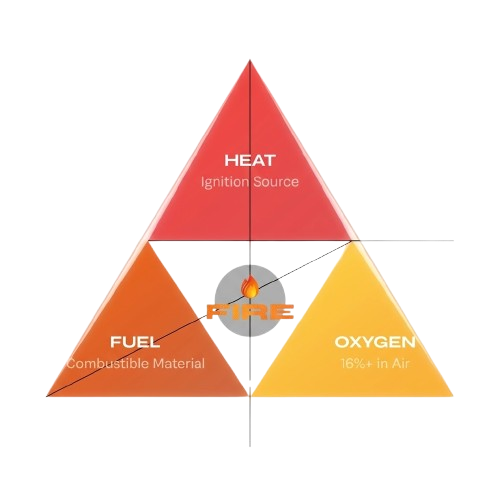
The Fire Triangle — Understanding What Starts & Stops Fires
Every fire requires three elements to ignite and sustain. Remove any one element and the fire goes out. This is the foundation of all fire prevention and suppression strategies.
Heat / Ignition Source
Any source of energy that raises material to its ignition temperature — sparks, flames, hot surfaces, electrical faults, friction, or sunlight.
Fuel
Any combustible material — solids (wood, paper), liquids (petrol, oil), or gases (LPG, methane) that can sustain the combustion process once ignited.
Oxygen
Oxygen at 16% or above in ambient air supports combustion. Normal air contains 21% oxygen — fire depletes this as it burns, eventually self-extinguishing in enclosed spaces.
Who Needs Fire Safety Training?
Fire can strike any workplace. These roles benefit most from formal fire
safety certification at STCS PK.
Factory & Industrial Workers
Production staff, machine operators, and supervisors in factories where flammable materials, hot processes, and electrical equipment create significant fire risks.
Construction Site Teams
Site managers, welders, electricians, and laborers working with open flames, hot work operations, and temporary site conditions that require fire hazard management.
Oil, Gas & Energy Sector
Rig personnel, pipeline workers, and refinery operators working with highly flammable hydrocarbons where fire is an ever-present hazard requiring specialist training.
Hotels & Hospitality Staff
Hotel managers, kitchen staff, and facility teams responsible for guest safety in buildings where fire detection, warden duties, and evacuation are legally required.
Hospitals & Healthcare Facilities
Healthcare administrators and facility managers responsible for fire safety in environments with non-ambulant patients, high oxygen use, and strict regulatory requirements.
Gulf-Bound Job Seekers
Professionals preparing for employment in Saudi Arabia, UAE, or Qatar where fire safety certification is consistently required by employers in construction, hospitality, and industry.
Assessment Process & How You Get Certified
STCS PK’s fire safety assessments combine written knowledge tests with practical demonstrations — ensuring every certified graduate can actually perform under pressure, not just answer questions.
Complete All Training Modules
Attend all theory and practical sessions. Our instructors ensure every participant is engaged and prepared throughout the course.
Written Knowledge Assessment
Sit a multiple-choice or short-answer written test covering fire science, fire classes, legislation, and warden procedures.
Practical Demonstration
Operate a live fire extinguisher, lead an evacuation exercise, and demonstrate fire warden duties under instructor observation.
Receive Your Certificate
Pass both components and receive your nationally and internationally recognized fire safety certificate — valid for 3 years, renewal training available.
STOS PK
CERTIFICATION
Tariq Mahmood
has successfully completed
Fire Warden / Marshal
Course
ISO 9001:2015 Certified Provider
Fire Safety Certificate
Recognized by Gulf employers & Pakistan industry — valid for 3 years
What Our Fire Safety Graduates Say
Real feedback from professionals who completed fire safety training
at STCS PK.
“The live fire extinguisher drill was the most valuable part. You don’t really understand how much training matters until you’re holding an extinguisher in front of a real flame. STCS PK gives you that confidence.”

“I needed fire safety certification for a job in Riyadh. STCS PK’s Emergency Response course was thorough — 3 days of real training including evacuation drills. Got the job within 3 weeks.”

“As an HSE Manager I needed a solid fire safety qualification to back up my work. The Advanced course at STCS gave me fire risk assessment skills I now use every week. Excellent instructors.”

Frequently Asked Questions
Everything you need to know about fire safety training at STCS PK. Our advisors are ready to help you choose the right level.
Still Have Questions?
Contact a fire safety course advisor directly — free guidance, no obligation.
What is the difference between the Fire Warden and Emergency Response courses?
The Fire Warden course (2 days) focuses on designated warden duties — evacuation management, alarm procedures, floor sweeps, and working with the fire brigade. The Emergency Response course (3 days) is more intensive and is aimed at HSE officers who may need to perform firefighting, rescue operations, and incident command at a more advanced level. Both include practical drills.
Is fire safety certification required for Gulf employment?
Yes. Most employers in Saudi Arabia, UAE, and Qatar — particularly in construction, hospitality, oil & gas, and industrial sectors — require fire safety certification as part of their HSE hiring criteria. Our certificates are recognized by Gulf employers and meet international fire safety training standards.
Does the course include live fire training with real extinguishers?
Yes — every fire safety course at STCS PK includes a live practical component. Students use real fire extinguishers on controlled fire scenarios. This hands-on experience is what sets our training apart from purely classroom-based programs and builds genuine confidence in emergency situations.
Which fire safety course should I take if I want to become an HSE officer?
We recommend starting with the Fire Warden course to build foundational competency, then progressing to the Fire Emergency Response course for the practical firefighting and incident management skills that HSE officer roles require. For senior HSE management positions, the Advanced Fire Safety Management course provides the most comprehensive qualification. Our advisors can build you a combined study plan.
can STCS Pk Deliver on site Fire Safety Training for Our Company?
Yes. STCS PK offers corporate on-site fire safety training at your workplace — including site-specific risk assessments, evacuation drills, and warden certification for your entire team. This is ideal for factories, construction sites, hospitals, and office buildings. Contact us to get a customized quote.
Get Fire Safety Certified
with STCS PK Today
Don’t wait for an emergency to discover your team isn’t prepared. Enroll in fire safety training
and protect lives, properties, and careers — in Pakistan and across the Gulf.