Essential First Aid Skills Every Worker Should Know
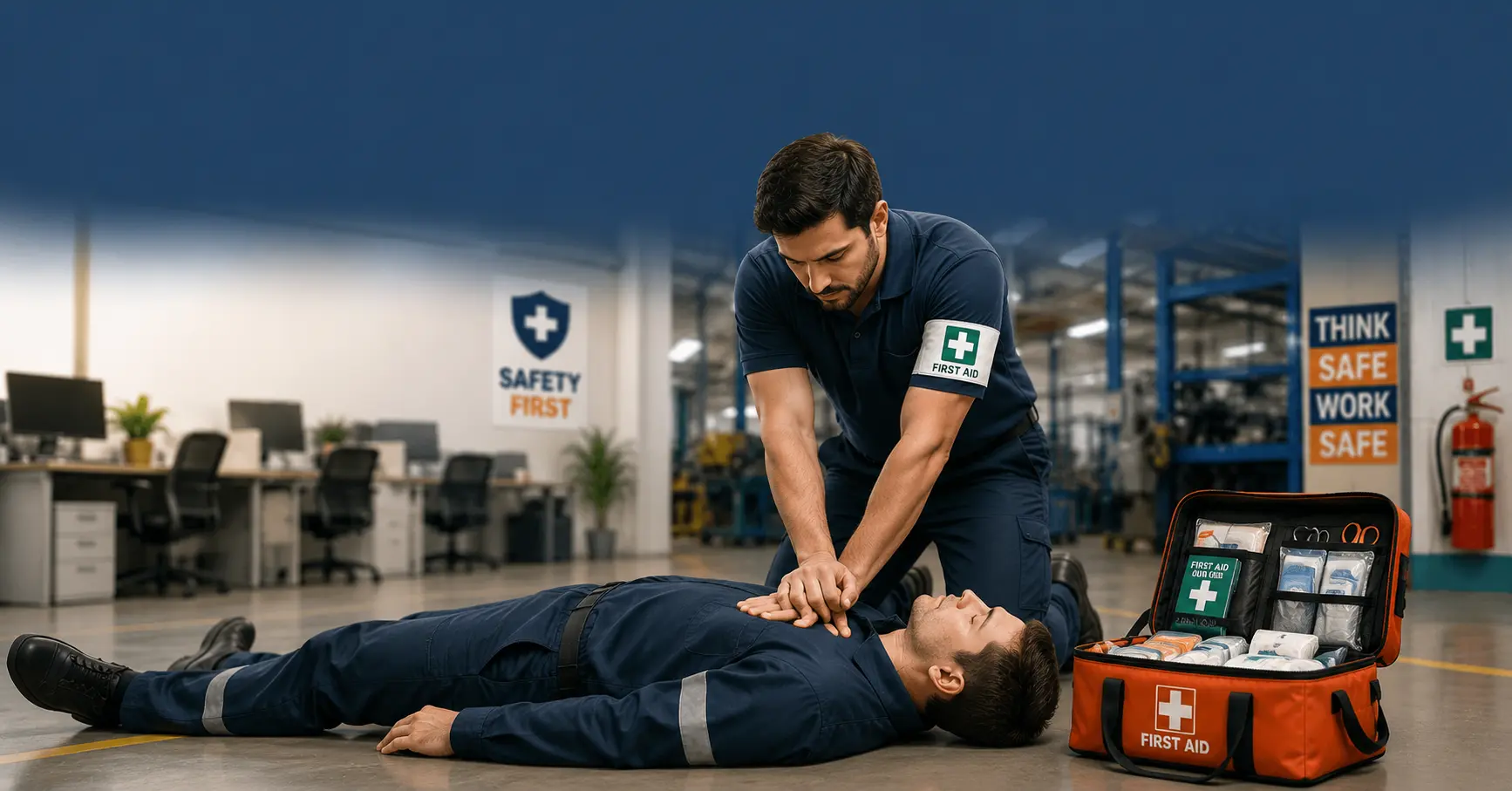
Accidents do not call when assistance is on call. A worker falls, a hand is cut on some machinery, a colleague chokes while taking his lunch break, and in that instant, the person standing right beside him or her becomes just as important as the ambulance that’s still 10 minutes away. The idea of a first aid course is to make normal workers the first line of protection between an accident and a tragedy.
Much of the outcome of an emergency can be decided during the first few minutes—and not during the hours in the hospital! — which are known as the “golden minutes. This guide provides information about the most important first aid skills workers need to know, what a good first aid course covers, and the important role this training plays in most workplaces, which many people don’t realize.
What Is a First Aid Course?
First aid course is a skill oriented course in which a person is taught how to identify, respond and treat injuries of medical emergencies before the arrival of a trained medical professional. It’s not all about the lecture, good first aid training involves hands on practice with mannequins, real bandaging techniques and practice providing first aid in scenarios that will actually occur in the real world.
Whether in the office, factory, construction site, school, warehouse, or at a remote location where medical assistance might be even further, these courses are relevant wherever people work.
Why First Aid Training Matters in the Workplace
- Faster response saves lives — many medical emergencies, especially cardiac arrest and severe bleeding, become fatal within minutes without intervention
- Reduces injury severity — correct initial care can prevent a manageable injury from becoming a permanent disability
- Builds workplace confidence — trained employees act decisively instead of freezing or making the situation worse
- Supports legal and HSE compliance — many workplace safety regulations require a minimum number of trained first aiders on-site
- Complements other safety training — first aid pairs naturally with fire safety training and broader HSE certification, since both deal directly with emergency response
Essential First Aid Skills Every Worker Should Know
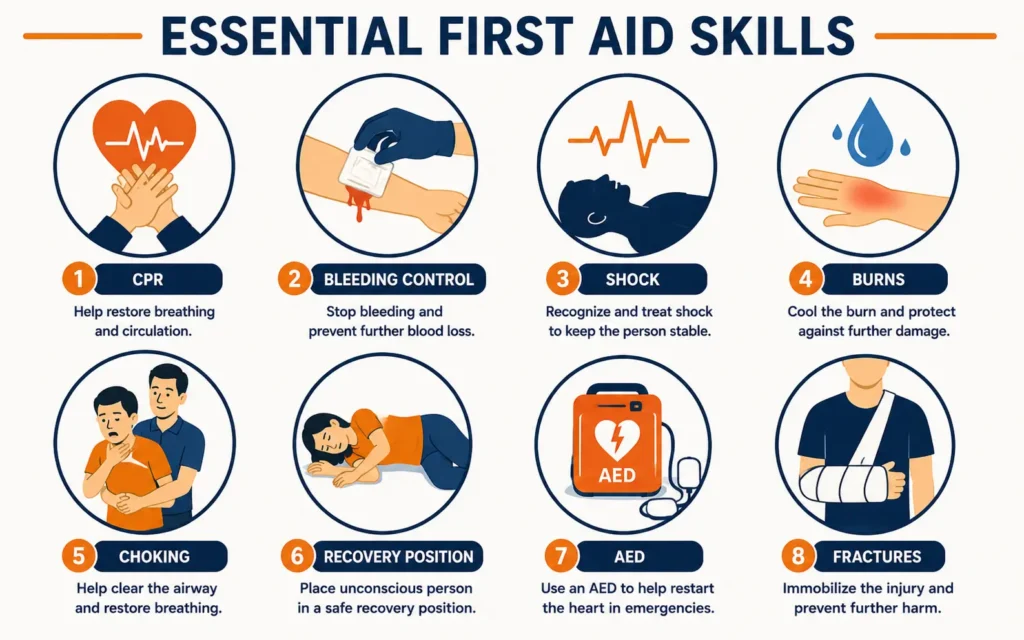
The key skills taught in a good first aid class — and those that are most likely to come in handy in an actual job emergency.
CPR (Cardiopulmonary Resuscitation)
CPR helps to circulate blood and oxygen if your heart has stopped. The workers are instructed in the proper compression depth, rate and hand position for chest compressions, and proper technique for rescue breathing, which can help a person survive until paramedics arrive.
How to treat cuts, wounds and bleeding control.
Good wound care will prevent infection and bleeding, ranging from minor cuts to serious lacerations. Training includes direct pressure technique, dressing and if a bleed is of sufficient severity and requires emergency transport.
Identifying and responding to shock
Blood loss, severe injury or trauma can lead to shock, which can happen very rapidly and can be more life-threatening than the injury itself. Employees are taught to identify early warning signs (paleness, fast pulse rate and confusion) and to correctly position & stabilise a casualty.
Handling Burns Correctly
Burns can be common in the industrial setting and in kitchens as well. Correct First Aid involves cooling the burn correctly and avoiding common errors of first aid (such as applying ice directly to the burn), as well as knowing when burns are an urgent medical emergency.
Choking Response
Knowing how to perform the Heimlich maneuver and back-blow techniques to help others who are choking are essential skills for responding to choking — one of the only times where a bystander’s immediate response is often the only thing that saves a life.
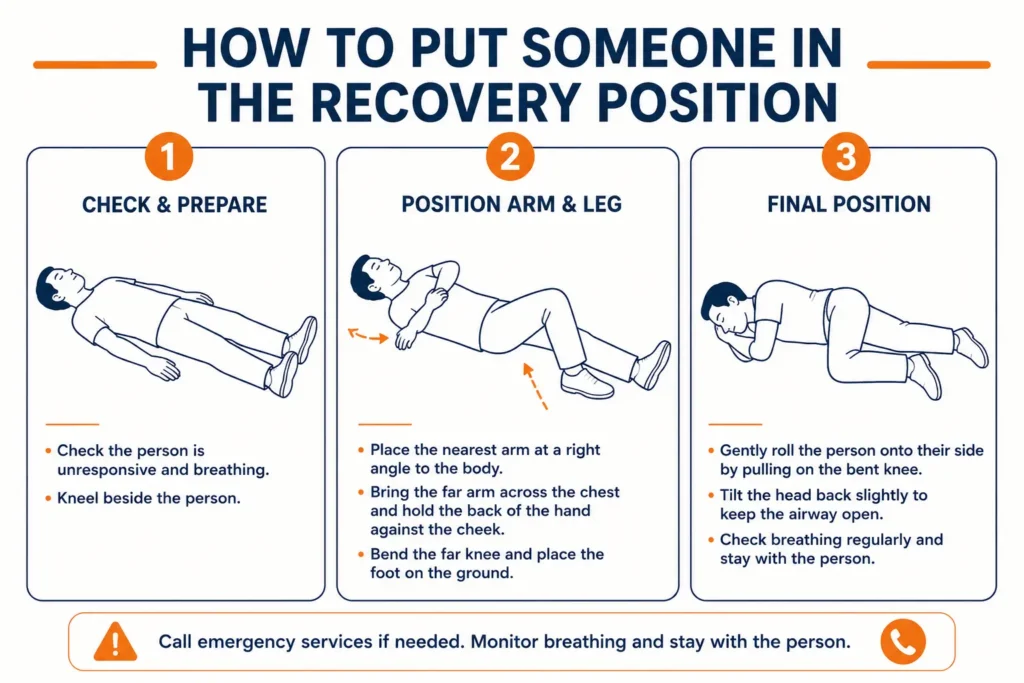
Treatment for Unconscious Casualties (Recovery Position)
The recovery position is used for an unconscious person breathing, to prevent them from choking if they vomit or their tongue falls down the back of the throat while waiting for help.
Using an AED (Automated External Defibrillator)
Training in the use of AEDs has become part of many first aid courses, as AEDs have become more common in the modern work place and public area. During a cardiac emergency, workers are instructed in the safe and proper use of one.
This course covers the knowledge and skills needed to treat minor fractures and sprains.
Correct immobilisation of an injured limb without aggravating the condition, is an essential prerequisite skill, especially in construction and industrial situations where falls and impact injuries are common.
Who Should Take a First Aid Course?
First aid training is valuable across nearly every industry, but it’s especially important for:
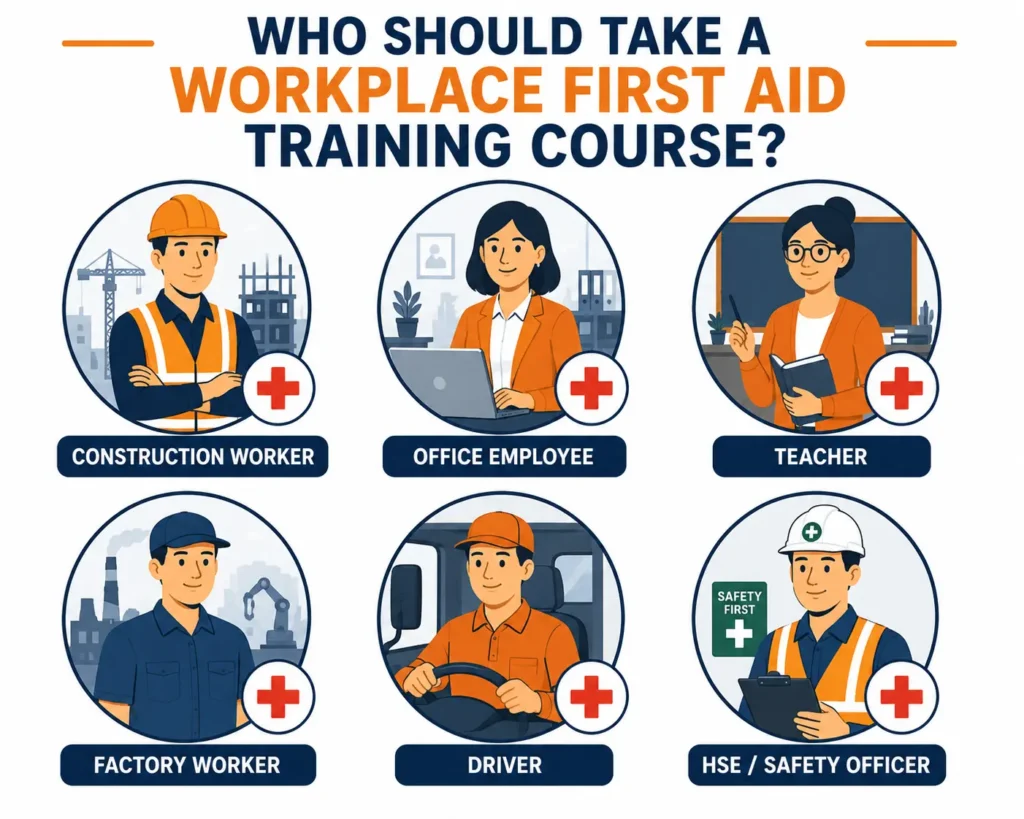
- Safety officers and HSE staff, often alongside broader safety officer career training
- Construction site workers and supervisors
- Factory and warehouse employees
- Office managers and HR personnel responsible for workplace welfare
- Teachers, school staff, and childcare workers
- Drivers and field staff working away from immediate medical access
In practice, the safest workplaces are the ones where multiple people — not just one designated “first aider” — know these basics.
First Aid Course Duration and Certification in Pakistan
Courses generally take a few days, up to a day or two, and are short, hands on and practical. Skills, such as CPR technique, can deteriorate with time and most safety experts do not see first aid as a certificate to be obtained at a single time but rather periodically refreshed. The length of time the course takes to complete or the qualification requirements may differ from institute to institute, therefore, check with your training institute for up to date information.
Career Opportunities After a First Aid Course
While first aid is often taken as a supporting certification, it directly strengthens job prospects in several ways:
- Workplace First Aid Responder — a designated role required in many companies under HSE compliance rules
- HSE Officer (with First Aid specialization) — combining first aid with broader safety certifications like NEBOSH or IOSH
- Site Medic Assistant — supporting roles on larger construction or industrial projects
- Stronger HSE candidacy overall — most employers view first aid certification as a baseline expectation for any serious safety officer or HSE professional, not an optional extra
Pairing first aid training with fire safety certification and a recognized safety qualification gives you a genuinely complete emergency-response skill set — exactly what employers look for when hiring for HSE roles.
Final Thoughts
Workplace emergencies do not usually give us much warning and rarely wait for trained medical personnel to arrive on the scene first. That’s where a first aid course comes in: it turns ordinary staff into effective first responders who can stabilize the situation, prevent it from escalating, and on many occasions, save a life before help arrives.
At STCS (Smart Trainings and Consultancy Services), our First Aid course combines hands-on practice with real emergency scenarios, designed for workers, supervisors, and HSE professionals across every industry. Explore our First Aid course or contact our team to get started.
A first aid course is a practical training program that teaches how to recognize and respond to medical emergencies — such as bleeding, choking, burns, and cardiac arrest — before professional help arrives.
Because in many emergencies, the first few minutes determine the outcome. Trained employees can prevent injuries from worsening and, in critical cases like cardiac arrest or choking, save a life.
Core skills include CPR, bleeding control, burn treatment, choking response, recovery position, AED use, and basic fracture management — all taught through hands-on practice.
It’s valuable for almost everyone, but especially safety officers, construction workers, office staff, teachers, and drivers — essentially anyone who could be the first person on the scene of an emergency.
Yes. First aid is often a baseline requirement for HSE and safety officer roles, and pairing it with certifications like NEBOSH, IOSH, or Fire Safety significantly strengthens your overall job candidacy.